

Scientists Identify Fifteen Key Motives Driving Human Behaviour

Researchers at HSE University and the London School of Hygiene and Tropical Medicine have identified 15 key motives that drive human behaviour. By analysing people's views, preferences, and actions through an evolutionary lens, they demonstrated how these motives intertwine to shape habits and interpersonal relationships. The findings have been published in Personality and Individual Differences.
The question of what motivates human behaviour has long intrigued psychologists. Various approaches are used to assess these underlying motives. The most well-known theory is Abraham Maslow's hierarchy of needs, introduced in the mid-20th century. However, most approaches emphasise the social aspects of motivation while overlooking its evolutionary underpinnings.
A group of researchers at HSE University and the London School of Hygiene and Tropical Medicine proposed analysing human behaviour motives from an evolutionary perspective. In the proposed framework, all motives are viewed as evolutionary adaptations that enhanced early humans' ability to survive in their environment and continue to influence behaviour today. The scientists proceed from the premise that if certain evolutionary mechanisms once triggered specific behaviours, the underlying motives can be identified using standard psychometric techniques.
To accomplish this, the study authors conducted an online survey with over 500 participants who were asked to rate 150 statements concerning their everyday preferences, fears, desires, and social aspirations. The statements were based on previously identified motives from other studies reflecting physical, reproductive, or social needs, such as 'I enjoy going on roller coasters,' 'Eating is less important to me than it seems to be for most people,' and 'I spend a lot of time staying in touch with my friends,' among others.
Using network analysis, the researchers identified stable clusters of motives. The study found that human behaviour is driven by 15 key motives, which can be grouped into five broad categories: environmental (Hoard, Create), physiological (Fear, Disgust, Hunger, Comfort), reproductive (Lust, Attract, Love, Nurture), psychological (Curiosity, Play), and social (Affiliate, Status, Justice).
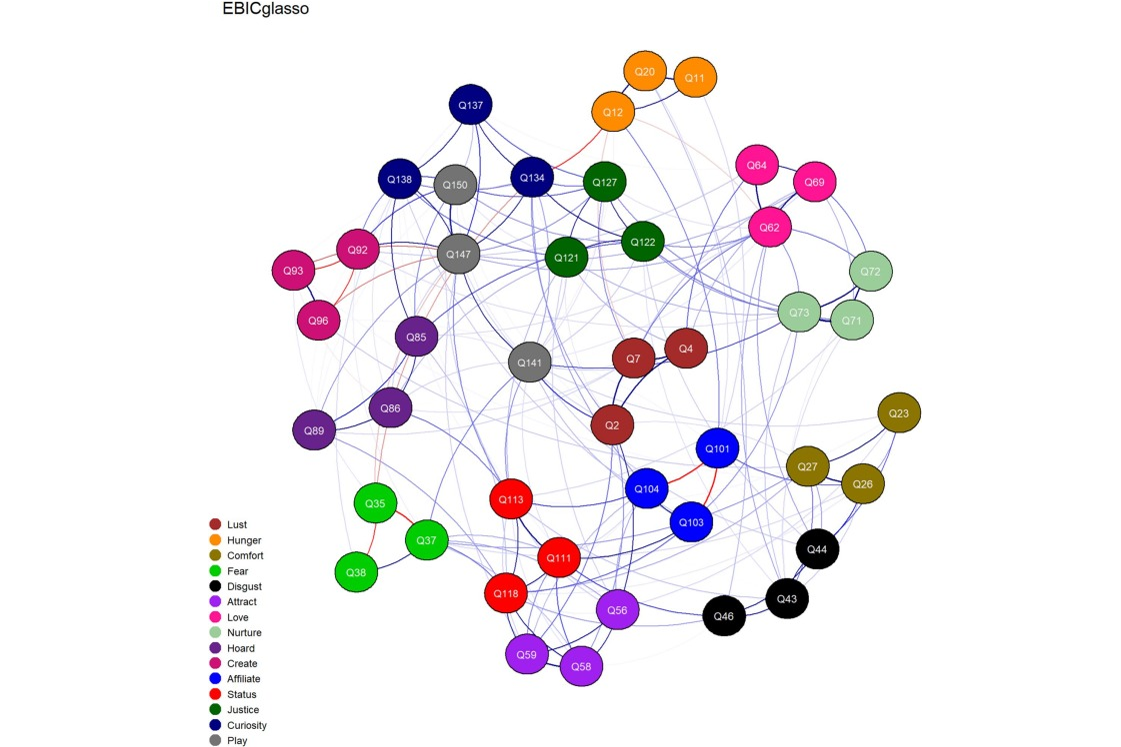
The researchers also identified functional relationships between motives, contributing to a deeper understanding of motivational structures. For example, Justice has strong ties to Nurture and Curiosity, suggesting that it is a function of both concern for the welfare of others and a need to keep abreast of where anti-social behaviours might be occurring.
Interestingly, the motives of Play and Status emerged as pivotal points of connectivity, interacting extensively with other nodes, suggesting they influence a broad range of related motives. Status appears to be important as it facilitates the attainment of other goals by providing access to resources that enhance the chances of success in life, including attracting a partner. Maintaining status involves hoarding resources, fearing the loss of these resources, and effectively using them in various situations. The motive of play, in turn, helps develop the skills needed to maintain status and adapt to changing circumstances.

'Using network-based psychometric techniques, we were able to observe how motives interrelate. For instance, the motives of Love and Nurture are positioned close to each other in the network, which makes sense from an evolutionary perspective, as caring for offspring enhances their chances of survival. Conversely, the motives of Fear and Curiosity often have opposing effects. Fear keeps us away from danger, but when excessive, it can suppress curiosity, which fosters knowledge and innovation,' explains Albina Gallyamova, Junior Research Fellow at the HSE Centre for Sociocultural Research.
The study also revealed age- and gender-related variations in the significance of different motives. Women tend to show a greater interest in the motives of Nurture and Comfort, while men are more likely to focus on the motives of Status and Attraction. The researchers note that these differences are linked to the traditional roles men and women played in our evolutionary past.
Age also contributes to shaping our priorities. Younger individuals tend to be more focused on Status and Play, while as people age, Fear and concern for Comfort become more prominent. 'These changes reflect different life stages: initially, we strive to secure our place in society, and later, we focus on safety and survival,' adds Gallyamova.
The study findings can be valuable in various fields, ranging from marketing to IT. For example, in advertising, understanding the motives of different social groups allows for more precise and effective communication. Youth focused on Status and Play are more likely to respond to incentives related to prestige and entertainment, while a more mature audience prioritises safety, reliability, and comfort. In the field of AI, understanding evolutionary motives enables a more human-centred approach, offering gamification and social interaction for younger users, while emphasising convenience and simplicity for the older generation. In therapy, understanding the underlying motives can help provide a more accurate response to the client's needs. For example, addressing anxiety can take into account the evolutionary mechanism of avoiding danger and help strike a balance between safety and curiosity.
'Ultimately, understanding the evolutionary motives that drive our behaviour enables us to create solutions that make people's lives more comfortable, safer, and more interesting,' explains Gallyamova.
See also:

Scientists Test Asymmetry Between Matter and Antimatter
An international team, including scientists from HSE University, has collected and analysed data from dozens of experiments on charm mixing—the process in which an unstable charm meson oscillates between its particle and antiparticle states. These oscillations were observed only four times per thousand decays, fully consistent with the predictions of the Standard Model. This indicates that no signs of new physics have yet been detected in these processes, and if unknown particles do exist, they are likely too heavy to be observed with current equipment. The paper has been published in Physical Review D.
HSE Scientists Reveal What Drives Public Trust in Science
Researchers at HSE ISSEK have analysed the level of trust in scientific knowledge in Russian society and the factors shaping attitudes and perceptions. It was found that trust in science depends more on everyday experience, social expectations, and the perceived promises of science than on objective knowledge. The article has been published in Universe of Russia.
Scientists Uncover Why Consumers Are Reluctant to Pay for Sugar-Free Products
Researchers at the HSE Institute for Cognitive Neuroscience have investigated how 'sugar-free' labelling affects consumers’ willingness to pay for such products. It was found that the label has little impact on the products’ appeal due to a trade-off between sweetness and healthiness: on the one hand, the label can deter consumers by implying an inferior taste, while on the other, it signals potential health benefits. The study findings have been published in Frontiers in Nutrition.
HSE Psycholinguists Launch Digital Tool to Spot Dyslexia in Children
Specialists from HSE University's Centre for Language and Brain have introduced LexiMetr, a new digital tool for diagnosing dyslexia in primary school students. This is the first standardised application in Russia that enables fast and reliable assessment of children’s reading skills to identify dyslexia or the risk of developing it. The application is available on the RuStore platform and runs on Android tablets.
Physicists Propose New Mechanism to Enhance Superconductivity with 'Quantum Glue'
A team of researchers, including scientists from HSE MIEM, has demonstrated that defects in a material can enhance, rather than hinder, superconductivity. This occurs through interaction between defective and cleaner regions, which creates a 'quantum glue'—a uniform component that binds distinct superconducting regions into a single network. Calculations confirm that this mechanism could aid in developing superconductors that operate at higher temperatures. The study has been published in Communications Physics.
Neural Network Trained to Predict Crises in Russian Stock Market
Economists from HSE University have developed a neural network model that can predict the onset of a short-term stock market crisis with over 83% accuracy, one day in advance. The model performs well even on complex, imbalanced data and incorporates not only economic indicators but also investor sentiment. The paper by Tamara Teplova, Maksim Fayzulin, and Aleksei Kurkin from the Centre for Financial Research and Data Analytics at the HSE Faculty of Economic Sciences has been published in Socio-Economic Planning Sciences.
Larger Groups of Students Use AI More Effectively in Learning
Researchers at the Institute of Education and the Faculty of Economic Sciences at HSE University have studied what factors determine the success of student group projects when they are completed with the help of artificial intelligence (AI). Their findings suggest that, in addition to the knowledge level of the team members, the size of the group also plays a significant role—the larger it is, the more efficient the process becomes. The study was published in Innovations in Education and Teaching International.
New Models for Studying Diseases: From Petri Dishes to Organs-on-a-Chip
Biologists from HSE University, in collaboration with researchers from the Kulakov National Medical Research Centre for Obstetrics, Gynecology, and Perinatology, have used advanced microfluidic technologies to study preeclampsia—one of the most dangerous pregnancy complications, posing serious risks to the life and health of both mother and child. In a paper published in BioChip Journal, the researchers review modern cellular models—including advanced placenta-on-a-chip technologies—that offer deeper insights into the mechanisms of the disorder and support the development of effective treatments.
Using Two Cryptocurrencies Enhances Volatility Forecasting
Researchers from the HSE Faculty of Economic Sciences have found that Bitcoin price volatility can be effectively predicted using Ethereum, the second-most popular cryptocurrency. Incorporating Ethereum into a predictive model reduces the forecast error to 23%, outperforming neural networks and other complex algorithms. The article has been published in Applied Econometrics.
Administrative Staff Are Crucial to University Efficiency—But Only in Teaching-Oriented Institutions
An international team of researchers, including scholars from HSE University, has analysed how the number of non-academic staff affects a university’s performance. The study found that the outcome depends on the institution’s profile: in research universities, the share of administrative and support staff has no effect on efficiency, whereas in teaching-oriented universities, there is a positive correlation. The findings have been published in Applied Economics.